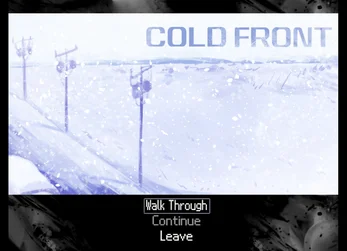
Cold Front
Everything You Need to Know About Cold Front
Cold Front Gameplay Videos
Cold Front - Full Walkthrough
Cold Front - All Endings Explained
What Is Cold Front?
Overview
Core Premise
Cold Front is a short, narrative-focused 2.5D game developed using the RPG Maker engine. Developed by RachelDrawsThis and STUDIO INVESTIGRAVE, it offers an estimated play time of 45 minutes to one hour. The game is not a traditional RPG; it is a hybrid that blends the aesthetics of a 2.5D pixel-art game with the mechanics of a psychological horror story, a visual novel, and an adventure-game-style exploration. It is available for PC and Mac platforms.
Genre & Style
- 2.5D RPG Maker: Pixel-art aesthetics with side-scrolling perspective
- Psychological Horror: Mental and emotional terror rather than jump scares
- Visual Novel: Story delivered primarily through dialogue choices
- Adventure Exploration: Environmental interaction reveals narrative context
What Makes It Special
A Concentrated Narrative Experience
Cold Front stands out as a concentrated, art-driven narrative experience created in just 25 days for a Korean RPG Maker game jam. The developer acknowledges that "the mechanics, puzzles and storytelling might feel a little short/less-dynamic" as a result of this time constraint, but this limitation actually serves the game's focus on psychological depth over mechanical complexity.
A Foundational Work
Cold Front is a foundational piece in the developer's larger portfolio of narrative-driven thriller and horror games. This game was created by the same developer who would later gain wider recognition for the game Dead Plate. Cold Front establishes the developer's signature themes—psychological horror, relational strain, and ambiguous, dream-like narratives—that are seen in their subsequent works like Elevator Hitch and Eloquent Countenance.
Story & Characters
The Setup
The Protagonists
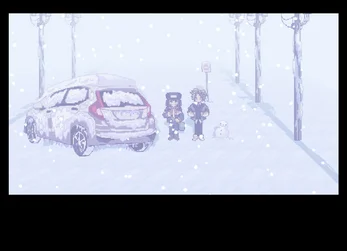
The plot centers on two childhood friends, Augustine and Winnie. They have been inseparable from elementary school through high school graduation. The game's conflict is set in motion by a life change: Winnie has been accepted to a university and is leaving town. The two decide to spend their last day together before he moves.
The Central Anomaly
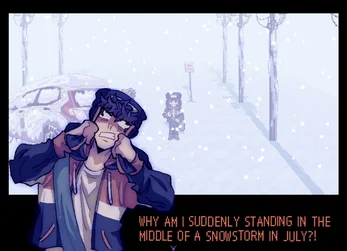
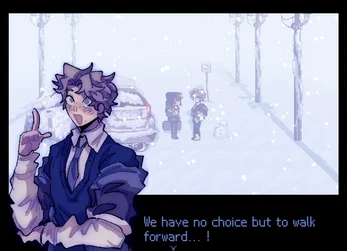
Not long after they get into Winnie's car, they are "suddenly trapped in a freezing blizzard even though it's the summer". This central anomaly—a blizzard in July—is the game's core hook. The stated objective is for the two to "work together to escape the chilling dangers they are suddenly forced into".
The Deeper Meaning
The Metaphorical Antagonist
The premise of a "blizzard in July" is a clear narrative signal that the game is not a literal survival story. The environment is a metaphor. The game is explicitly described as a "psychological story" about "how our mind can act as our true worst enemy". Other players have characterized it as being about "the horrors of not telling your friends how you feel".
This reveals that the "Cold Front" of the title is a double-entendre. It is not a meteorological phenomenon but the emotional and relational distance that has grown between Augustine and Winnie. The cold, the snow, and the "chilling dangers" are physical manifestations of Augustine's internal psychological state—his jealousy, his fear of abandonment, and his unspoken resentment. The true antagonist of the game is this emotional divide.
Character Analysis
Augustine (Player Character)
- Childhood friend struggling with complex emotions
- Experiencing jealousy and fear of abandonment
- Must confront unspoken feelings about Winnie's departure
- The psychological landscape is a reflection of his inner turmoil
Winnie
- Accepted to university and leaving town
- Long-time friend since elementary school
- Represents both friendship and the source of Augustine's anxiety
- Central to Augustine's emotional conflict
The Revelation
The Core Plot Twist
The narrative strategy reveals the game's central plot twist: the entire game is a psychological "coma dream" or a manifestation of Augustine's mental state in the moments immediately following a car crash.
- The game begins with the two friends getting into a car
- Both endings culminate in a scene at the real-world location of a car accident, complete with an ambulance
- The central premise—a blizzard in July—is a physical impossibility and is framed as a "psychological story"
The conclusion is that the blizzard, the "chilling dangers," and the monstrous figures are not real. They are a metaphorical landscape inside Augustine's mind. The "game" is a subconscious battle for Augustine to process the accident and his complex feelings. The monster he flees is his own jealousy and resentment.
Gameplay Mechanics
Core Mechanics
The Primary Loop
Gameplay in Cold Front is simple and cycles through three distinct phases:
- Visual Novel: The bulk of the story is delivered through dialogue boxes. The player, as Augustine, makes key dialogue choices that shape his relationship with Winnie.
- Exploration: The player controls a 2.5D pixel-art character in small, contained environments. The primary interaction is moving and interacting with objects, which provides story context and clues.
- Chase Sequences: There are short, scripted "action" segments where the player must navigate a path to escape a monstrous figure.
Control Scheme
- Movement: Arrow keys or WASD
- Interaction: Space bar or Enter
- Menu: ESC or X
Technical Challenges
The Chase Sequence Issue
From a player's perspective, the most significant mechanical hurdle is a specific monster chase sequence. However, community reports indicate this is not due to intended difficulty but to technical issues. Players have reported that the game "lags and I end up dying". One user provided a detailed report, stating, "the monster gets me before I can start running since it loads before I can run away," and even captured an image where they were caught "literally before the screen was loaded in".
Developer's Solution
The developer responded to this issue, explaining that "the chase doesn't actually start until you take 3-4 steps." Therefore, the solution is to "don't press any movement keys and wait until the map is visible." Players can simply stand still until the screen has fully loaded, at which point they can "start your chase" without being unfairly caught.
Alternative Strategy
For those who still experience lag, another player found a workaround: "running by the very right lets you avoid most of the obstacles". This path seems to be the clearest and most forgiving, mitigating the effects of lag-induced deaths.
Design Philosophy
Narrative Over Mechanics
The game's outcome is not ultimately decided by success or failure in the chase sequence, but by the player's dialogue choices. The game "branches based on how Augustine handles his emotions". The developer's decision to make the mechanics "less-dynamic" was likely intentional, as it forces the player to focus on the only mechanic that truly matters: the narrative. Decision-making and exploration are the crucial roles, not combat or complex puzzles.
Cold Front prioritizes narrative depth over mechanical complexity. The simple control scheme and straightforward gameplay loop ensure that players remain focused on the emotional journey and dialogue choices that determine the game's outcome.
Endings Guide - Good & Bad Endings
How Endings Work
The Narrative Fork
Cold Front features two primary endings. The branching point that determines the ending is not a single, final choice, but the culmination of dialogue choices made throughout the game. The ending "branches based on how Augustine handles his emotions" and how he responds to Winnie in key moments.
Determining Your Path
Your ending is determined by your consistent behavior pattern throughout the game:
- Choose compassion over jealousy
- Select emotionally honest responses
- Support Winnie's decisions
- Express vulnerability rather than resentment
- Communicate feelings openly
The "winning" strategy for Cold Front is not mechanical, but thematic. The game is about the failure of communication. Therefore, to achieve the "Good Ending," the player must actively choose to communicate. The strategic "trick" is to role-play as Augustine having a breakthrough. The player must select dialogue options that are emotionally honest, vulnerable, and supportive of Winnie, rather than the options that are jealous, cold, or evasive.
The Two Endings
Bad Ending
This path is achieved by choosing dialogue options that reinforce Augustine's isolation, jealousy, and resentment. The player must lean into the "Cold Front" by being cold and distant.
What Happens
In this path's climax, Augustine pushes Winnie off a set of stairs. This metaphorical act of betrayal leads to the game's final, chilling reveal. The setting shifts to the real world, at the scene of the car accident. Augustine, who "only has minor injuries", sees the ambulance and looks over to see that Winnie is dead. Upon this realization, Augustine "grinned".
He is "happy that Winnie is dead" because, in his twisted psychological state, he is finally "feeling noticed and cared for" by the people comforting him—attention he felt Winnie was stealing. This represents Augustine succumbing to his resentment, effectively "killing" Winnie in his own mind.
Good Ending
This path is achieved by choosing dialogue that breaks down the "lack of communication". The player must make Augustine confess his true feelings—his fear of being left behind and his jealousy—and ultimately reconcile with Winnie.
What Happens
This path also concludes at the ambulance scene after the car crash. However, because Augustine has achieved a psychological reconciliation, the outcome is different. Instead of a grim death, the ending is described by players as "heartwarming", beautiful, and emotional, bringing many to "tears".
It represents Augustine's choice to reaffirm his friendship over his resentment. The "Good Ending" represents him conquering that part of himself and holding on to their friendship as he "wakes up" to reality.
Replay Value
Many players replay Cold Front to experience both endings and discover how different dialogue choices lead to dramatically different emotional outcomes. The short playtime (45 minutes to 1 hour) makes it easy to replay and explore alternative paths.
Tips & Tricks for Success
Exploration Tips
General Exploration
The primary tip for progressing the story is to be thorough. As one guide suggests, "Exploration is key: Interact with everything". Seemingly minor environmental objects often provide context for Augustine's internal state and his relationship with Winnie.
What to Look For
- Environmental objects: Click on furniture, posters, and background items
- Character details: Pay attention to how characters are positioned and described
- Color symbolism: Note the use of cold colors and imagery
- Repeated motifs: Watch for recurring themes and symbols
Technical Solutions
Surviving the Chase Sequence
For the chase sequence that has been identified as buggy, players have developed two key strategies to bypass the technical flaws:
Developer-Acknowledged Solution
The developer responded to a complaint, explaining that "the chase doesn't actually start until you take 3-4 steps." Therefore, the solution is to:
- Don't press any movement keys immediately
- Wait until the map is fully visible
- Stand still until the screen has completely loaded
- Then start your chase without being unfairly caught
Player-Sourced Solution
For those who still experience lag, another player found a workaround:
- "Running by the very right lets you avoid most of the obstacles"
- This path seems to be the clearest and most forgiving
- It mitigates the effects of lag-induced deaths
Performance Optimization
- Save frequently: Use the save points provided
- Let screens load: Don't rush through scene transitions
- Close other applications: If experiencing lag, close background programs
- Check system requirements: Ensure your system meets minimum specs
Dialogue Strategies
For Good Ending
To achieve the "Good Ending," focus on these dialogue strategies:
✅ Always choose compassion and kindness ✅ Express your true feelings honestly ✅ Support Winnie's life choices ✅ Show vulnerability rather than hiding emotions ✅ Choose communication over avoidance ✅ Be emotionally honest even when it's difficult
For Bad Ending
To achieve the "Bad Ending" (if you want to experience this path):
❌ Choose jealous or resentful responses ❌ Be cold and distant ❌ Avoid expressing true feelings ❌ Show anger or passive aggression ❌ Prioritize your own hurt over the relationship
Strategy Insights
The Core "Trick"
The "winning" strategy for Cold Front is not mechanical, but thematic. The game is about the failure of communication. Therefore, to achieve the "Good Ending," the player must actively choose to communicate.
The strategic "trick" is to role-play as Augustine having a breakthrough. The player must select dialogue options that are emotionally honest, vulnerable, and supportive of Winnie, rather than the options that are jealous, cold, or evasive.
Maximizing Your Experience
Creating the Right Atmosphere
- Play in a quiet environment: The game's emotional impact is best experienced without distractions
- Read all dialogue carefully: Small details matter for understanding the story
- Take your time: Don't rush through the narrative
- Replay for both endings: Experience both paths to fully understand the story
Frequently Asked Questions
Yes, Cold Front is completely free to download and play on itch.io. It's a short narrative-driven experience developed by RachelDrawsThis and STUDIO INVESTIGRAVE.
Single playthrough: 45 minutes to 1 hour Both endings: 2-3 hours
The game is relatively short but highly replayable due to its branching narrative and two distinct endings.
Cold Front is available for: PC: Windows Mac: macOS
The game was created using RPG Maker and is available exclusively through itch.io.
Cold Front has 2 primary endings:
- Good Ending - Achieved by making emotionally honest dialogue choices that support Winnie
- Bad Ending - Achieved by choosing jealous, cold, or evasive responses
The ending is determined by your cumulative dialogue choices throughout the game, not a single final decision.
Latest Comments
No comments yet. Be the first!